

Deel vs Remote EOR
Deel vs Remote is what you are trying to evaluate? You’re not alone. Both are leading global EOR platforms — and picking the wrong one is an expensive mistake. I’ve done a deep Deel versus Remote evaluation so you can decide fast.
And I’ll tell you upfront: I recommend Deel for most companies, and I’ll show you exactly why with real data. But I’ll also tell you where Remote genuinely wins — because sending you to the wrong tool would be a lousy thing to do, and frankly, you’d figure it out anyway.
I’ll break it all down How Deel Compares to Remote stacks up.
Deel Against Remote.com & What Are These Both Platforms?
Before the comparison, a quick primer if you are new to these platforms.
Both Remote & Deel are EOR platforms. Employer of Record (EOR) is basically a legal hack for global hiring. Instead of spending 6 months and $20,000 setting up a legal entity in Germany just to hire one engineer — you use an EOR. The EOR hires that person on your behalf, handles local payroll, taxes, benefits, and compliance, and you just pay a monthly fee. Your employee works for you day-to-day. The EOR solution handles the legal paperwork.
What is Deel (What Kind of Platform is Deel?)
Deel is an all-in-one global HR and payroll platform & acts as an Employer of Record (EOR) that lets companies hire, manage, and pay employees and contractors in 150+ countries without setting up a local legal entity.
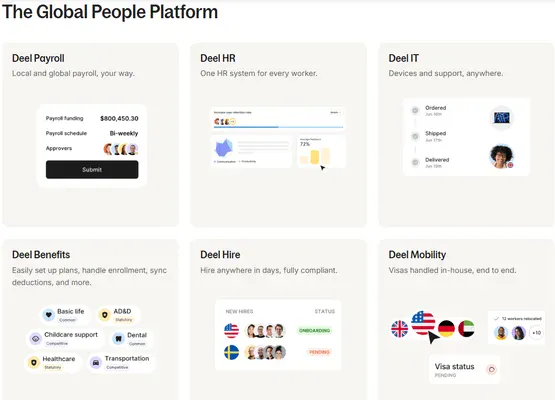
Deel launched in 2019, backed by Y Combinator, and has since grown into the largest all-in-one global HR platform in the world — serving 40,000+ (source deel homepage, per Deel’s published company stats, deel.com, as of June 2026) companies including Revolut, Canva, and LinkedIn.

It covers EOR, contractor management, global payroll, HRIS, immigration, IT equipment, and equity. In case you need more info, read this Deel Review
What Deel Does (How it works)
Deel operates primarily as an Employer of Record (EOR) and global contractor management platform, handling the legal and administrative work of international employment on a company’s behalf.
Core Capabilities (What Actually Makes Remote Different)
Explore Deel capabilities here –>
What is Remote.com
Remote is a global Employer of Record (EOR) and payroll platform built around one core differentiator: it owns 100% of its legal entities in the countries where it offers EOR, rather than using third-party local partners. Remote launched around the same time as Deel. It has a clean interface, solid compliance, and strong IP protection.
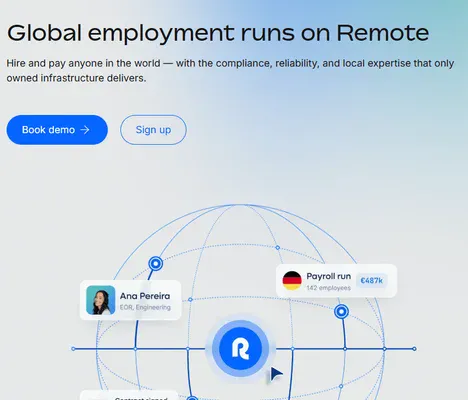
Remote.com EOR coverage (via owned entities) spans 80–90+ countries; its contractor management product covers a much wider range of countries and territories, since contractor payments don’t require a local legal entity.
Core Capabilities:
Both EOR platforms are legitimate platforms used by real companies.
Deel Or Remote EOR Comparison
Note: several of these criteria (immigration, equity, IT) are products Remote doesn’t sell as separate line items — not necessarily gaps for a buyer who doesn’t need them. Weight these by your actual needs, not by raw count.
| Criteria | Deel | Remote | Winner |
|---|---|---|---|
| EOR Pricing | $599/mo/per employee (Annual plan) | $699/mo/per employee (Annual plan) but $699 (monthly plan) | ✅ Deel (more value at same price) |
| Global Payroll Pricing | $29/employee/mo | $29 per employee/mo | ✅ Deel |
| Country Coverage | 150+ countries | 80+ countries | ✅ Deel |
| Product Suite Depth | EOR, Payroll, HRIS, IT, Immigration, Equity, AI | EOR, Payroll, Contractor, HR Suite | ✅ Deel |
| Enterprise Integrations | Workday, NetSuite, BambooHR, Slack, 100+ more | Standard integrations only | ✅ Deel |
| Crypto / Multi-Currency Payments | ✅ 150+ currencies including crypto | ❌ Limited | ✅ Deel |
| Immigration Support | ✅ In-house (Deel Mobility) | ❌ Not offered | ✅ Deel |
| Equity Management | ✅ Yes | ❌ No | ✅ Deel |
| IT Equipment Management | ✅ Yes (Deel IT) | ❌ No | ✅ Deel |
| Contractor Management Pricing | $49/month per contractor | $29/month per contractor | ✅ Remote |
| Owned Entities Model | Mixed (owned + select partners) | 100% owned entities | ✅ Remote |
| IP Protection (Contractors) | Standard | Strong dedicated clauses | ✅ Remote |
| Platform UX | Very Good (improving fast) | Excellent | ✅ Remote |
| Free Contractor Tier | ❌ None | ✅ First contractor free | ✅ Remote |
| Compliance Depth (complex cases) | ✅ 2,000+ local experts | Good (standard cases) | ✅ Deel |
| Customer Support (Enterprise) | ✅ Strong, dedicated managers | Strong | ✅ Deel |
Here’s How Deel compared to Remote Stacks Up (If You’re Short on Time)
| Your Situation | My Pick |
|---|---|
| Hiring full-time employees globally at scale | Deel |
| Need payroll + HRIS + immigration in one platform | Deel |
| Hiring in 10+ countries or niche/emerging markets | Deel |
| Building a remote-first team across Europe & APAC | Deel |
| Managing just 1–2 contractors on a tight budget | Remote |
| IP-sensitive hiring with developers/designers | Remote |
| Want fastest onboarding for a small team | Remote |
Ready to try Deel? 👉 Book a Free Demo With Deel Team
Which is Better, Deel or Remote? (Detailed Feature Difference Between Deel and Remote)
If you are short of time, here is video version for you to check;
1. Deel vs Remote Pricing
Let’s put the numbers side by side.
Deel Pricing
Remote Pricing
💡Fact: Nearly Equal on EOR, but Deel Wins on Payroll
The Honest Breakdown
On EOR, the base rate is identical — $599/month — if you commit annually. But Remote charges $699/month on a monthly plan. If you’re not ready to lock in, Deel gives you more flexibility at the same price point.
The bigger gap opens up on Global Payroll. Deel publishes a transparent rate starting at $29/employee/month. Remote requires you to contact sales for a quote. Personally, when a company hides its pricing behind a sales call, that’s a yellow flag. It usually means the number isn’t going to make you happy.
Where Remote genuinely wins on pricing: contractor management. At $29/month vs. Deel’s $49/month, Remote is cheaper for early-stage companies managing just a few contractors. I’ll be honest about that — if you’re a solo founder with two overseas contractors and $200/month in budget, Remote saves you money upfront.
But the moment you start scaling — more employees, more countries, more product needs — Deel’s all-in-one value proposition starts making more economic sense than paying for multiple point solutions.
💡 Want to see what Deel would cost for your team size? 👉 Get a free Deel pricing estimate here
2. Country Coverage
💡Deel: 150+ countries. Remote: 80+ countries. That’s not a small gap. It’s nearly double the reach. Deel Covers Nearly Twice the World
Now, I want to be fair here — for most companies hiring in Western Europe, North America, India, or Southeast Asia, these two EOR giants cover your core markets. But here’s where that 70-country difference actually hits you in practice:
Situation 1: You’re scaling fast. You start in the UK and Germany. Then a great candidate shows up in Nigeria. Then you need someone in Vietnam. Then Pakistan. With Deel, you expand without switching platforms. With Remote, you may hit a wall and need to find a workaround or a secondary provider — which doubles your admin headache.
Situation 2: You want to hire in emerging markets. Latin America, sub-Saharan Africa, parts of the Middle East — Deel’s wider footprint gives you access to talent pools that Remote simply can’t serve.
Situation 3: You’re a global-first company from day one. If your hiring strategy is “best talent, anywhere in the world,” you need maximum optionality. Deel gives you that.
Remote’s counterargument is quality over quantity — their 80+ countries all use owned entities with no third-party partners. That’s a legitimate point, and I’ll address it in the compliance section. But for companies that want to grow internationally without limits, Deel’s 150+ country footprint is a meaningful, practical advantage.
3. Compliance & Legal
Compliance is where EOR platforms either justify their fees or quietly expose you to risk. Let’s be specific.
Why Deel’s Compliance Depth Stands Out
Deel employs 2,000+ local compliance and legal experts and has built its own proprietary payroll engine — meaning it doesn’t outsource payroll processing to third parties. That in-house infrastructure matters when things get complicated.
Deel covers scenarios that Remote simply doesn’t offer products for:
Remote’s Compliance Strength (Being Honest)
Remote’s one genuine compliance advantage is its 100% owned entities model. When Remote hires your employee, it does so through its own legal entity in that country — no partner, no middleman. Deel uses a mix of owned entities and carefully vetted partners, particularly in smaller markets.
In practice, this means Remote has a slightly cleaner chain of legal accountability in the markets it covers. For standard EOR in mainstream countries, that consistency is real. Remote also includes IP transfer clauses as standard in contractor agreements — a legitimate win for companies where IP creation is the core of what you’re buying.
💡 The verdict: For standard EOR in Remote’s 80 markets, compliance quality is comparable. But the moment your situation gets complex — immigration, equity, emerging markets, misclassification risk — Deel’s depth and breadth of in-house expertise pulls ahead significantly. 👉 Check Deel’s Compliance Depth here
4. Product Suite
This is the section where I feel most strongly about Deel, and here’s why.
When you hire internationally, the payroll and legal compliance are just the start of what you need to manage. You also need to think about:
Deel has a product for every single one of those. Here’s the full suite:
💡Deel Is the All-in-One. Remote Is Not.
Remote’s product suite covers EOR, contractor management, global payroll, and a core HR suite. It does those things well. But it doesn’t offer immigration, equity, or IT management — so if you need those, you’re paying for additional tools and stitching them together yourself.
For a growing company that wants operational simplicity — everything in one login, one vendor, one support team — Deel’s breadth is a genuine competitive advantage over Remote.
5. Platform UX
I’m going to give Remote honest credit here, because their UI is genuinely excellent.
My take: Remote wins on first impression. For a lean HR team of 1–2 people that just wants to manage a handful of EOR employees, Remote’s simplicity is a genuine win. But for teams that are actually using the full depth of Deel’s product suite, the complexity pays for itself quickly. Remote Is Cleaner, But Deel Is Catching Up
6. Integrations
If your company runs enterprise tools, this section is important.
Deel Connects With Your Entire Tech Stack
Deel integrates natively with:
Ready to try Deel? 👉 Book a Free Demo With Deel Team
Remote integrates with: BambooHR, Greenhouse, Slack, QuickBooks, and a smaller selection of standard tools.
The integration gap doesn’t matter much for a 10-person startup. But the moment your finance team runs on NetSuite and expects payroll data to sync automatically, or your HR team uses Workday as their system of record — Deel’s integration depth becomes a real operational advantage that you can check here
7. Customer Support
Note: These support claims are based on general market sentiment, not a specific survey — verify current SLAs with both vendors directly.
Both platforms have received mixed reviews on support at smaller account sizes — let’s be honest about that. Ticket response times can stretch for low-volume accounts on any EOR platform.
Deel holds a 4/5 rating across 6,825 + reviews on G2 and roughly 4.6+ stars on Trustpilot from 8,900+ reviews, with reviewers frequently praising responsiveness but flagging delays on complex cases. Remote shows 4000+ reviews on G2 and 3000+ review with 4 stars on Trustpilot, with users praising staff helpfulness but some noting slower response times as account complexity grows. Ratings change over time — check current scores directly before publishing. Note: These rating and review numbers are sourced from globally recognised platforms and are often changing.
Practical advice for either platform: Before you sign anything, ask specifically what your support SLA looks like. Get it in writing. Don’t assume “24/7 support” means what you think it means.
Who Should Actually Choose Remote? (Being Fair)
Here are the genuine cases where Remote is the better choice:
1. You’re managing 1–2 contractors on a tight budget. Remote’s $29/month contractor rate vs. Deel’s $49/month is a real saving when you’re just starting. The free first contractor tier helps too.
2. IP protection is your #1 priority. Remote’s owned-entity model and standard IP transfer clauses in contractor agreements are genuinely stronger than Deel’s standard offering. If you’re hiring developers or designers and you’re paranoid (understandably) about IP ownership, Remote’s setup offers tighter legal protection.
3. You only need core EOR in Western markets. If you’re hiring in 3–5 well-covered countries, want a clean interface, and don’t need payroll, immigration, or equity — Remote’s focused product does the core job well.
For everyone else? I’d point you toward Deel. The scale, breadth, and long-term optionality are worth it.
Real World Scenarios
🚀 Scenario 1: Series A Startup, Hiring 5–15 Employees in Europe + India
- Deel. Both platforms cover these markets. But Deel’s HRIS, payroll engine, and integrations with tools like BambooHR set you up for the next phase of growth. Don’t re-platform in 18 months — start right.
🌍 Scenario 2: Scale-Up Expanding Into 15+ Countries Including Emerging Markets
- Deel, without question. Remote’s 80-country limit will become a constraint. Deel’s 150+ countries give you the runway to hire wherever talent exists.
🛠 Scenario 3: Tech Company Granting Equity to Global Team
- Deel. Remote has no equity management product. Deel handles stock option structuring and tax implications across jurisdictions. If equity is part of your comp strategy, this is a clear call.
✈️ Scenario 4: Need to Relocate a Key Hire to Another Country
- Deel. Deel Mobility handles visas, work permits, and immigration end to end. Remote doesn’t offer this service at all.
💼 Scenario 5: Enterprise Company on Workday or NetSuite
- Deel. The integration depth isn’t even close. Deel’s native Workday and NetSuite connectors are built for enterprise finance teams.
👩💻 Scenario 6: Solo Founder, 1–2 Overseas Contractors, Tight Budget
- Remote (honestly). At this size, the cheaper contractor rate matters more than product breadth.
Deel Versus Remote | FAQs
Is Deel better than Remote?
For most companies — yes. Deel covers more countries, offers a more complete product suite, and integrates more deeply with enterprise tools. Remote is better in specific situations (IP-sensitive contractor work, very small teams, budget-first decisions).
Is Deel more expensive than Remote?
At the EOR level, the base price is the same: $599/employee/month on annual plans, while Remote.com is priced at $699/mo/per employee (Annual plan) but $699 (monthly plan). Deel’s contractor management is more expensive ($49/month vs. Remote’s $29/month). But Deel’s global payroll is transparently priced.
Does Deel cover more countries than Remote?
Yes — 150+ vs. 80+ countries. For mainstream markets, both work. For emerging markets and global scale, Deel has a significant edge.
Can Deel handle immigration and visas?
Yes. Deel Mobility is a dedicated in-house immigration team. Remote does not offer immigration services.
Is Remote’s owned-entity model better for compliance?
For the 80+ markets Remote covers, yes — 100% owned entities means more consistency. But Deel’s compliance depth in complex cases (equity, immigration, misclassification) compensates for its mixed model.
Can I switch from Remote to Deel later?
Technically yes, but it involves re-onboarding employees under new contracts. It’s doable but disruptive. It’s far better to make the right choice now — which is why I’d recommend starting with Deel if you expect to scale.
Final Verdict: Is Deel Better Than Remote?
Why Deel Wins for Most Companies? After going through every major category, here’s where I land with Remote vs Deel:
Deel is the stronger platform for:
Remote is the better fit for:
For the vast majority of growing companies I’ve talked to?
Deel is the better long-term bet. The wider country coverage, deeper product suite, and enterprise-grade infrastructure give you a platform that grows with you rather than hitting ceilings at 80 countries or missing key features you’ll need in year two.
If this Deel vs Remote comparison has you leaning toward Deel, here’s what I’d suggest:
- Book a free demo — Deel’s sales team will walk you through the exact products relevant to your use case and give you a real pricing estimate.
- Tell them your country list — ask specifically which markets use Deel’s owned entities vs. partners, so you know exactly what you’re getting.
- Ask about the HRIS free tier — Deel HR is free for up to 200 employees, which is a meaningful saving if you’re consolidating platforms.
Affiliate Disclosure: This article contains affiliate links. If you sign up for Deel through my link, I may earn a commission at no extra cost to you. I only recommend tools I genuinely believe in — and I’ll be upfront about where Remote actually wins too. No sugarcoating here.
