

Nowadays AI is transforming global hiring workflows like anything.
Artificial intelligence in hiring has quietly split into two categories of companies: those running AI-assisted, self-improving hiring pipelines, and those still screening resumes by hand while their time-to-hire slips further behind.
The gap isn’t theoretical anymore. It shows up in the numbers, in the regulatory filings HR teams are scrambling to produce, and in how fast a distributed team can actually get someone paid, compliant, and productive across borders.
For companies hiring internationally, this year AI in recruitment stopped being a recruiting add-on and became infrastructure.
But infrastructure only works if the layer underneath it — payroll, classification, tax residency, employment contracts — is solid.
That’s the part AI doesn’t solve, and it’s the part this article is really about.
Disclosure: This article contains an affiliate link
How AI Is Transforming Global Hiring Workflows in 2026
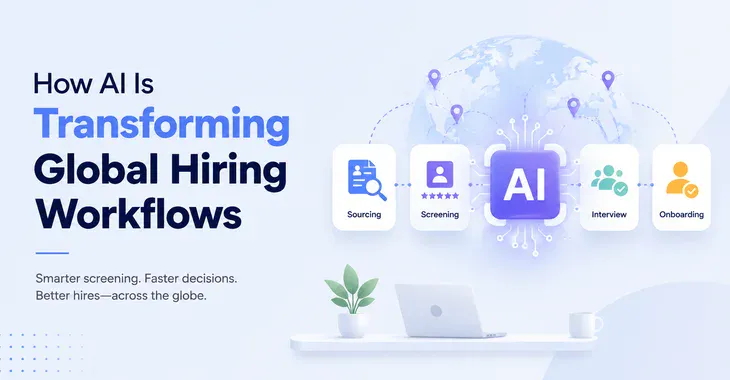
AI Adoption in Hiring Has Crossed a Threshold
The scale of adoption is no longer a niche statistic buried in an HR tech report. As of early 2026, the majority of recruitment workflows now incorporate at least one AI-driven tool, a shift industry researchers describe as AI moving from a discretionary feature to a baseline requirement for competitive hiring, according to Fueler’s 2026 AI in Hiring report.
SHRM data cited in the same wave of research shows AI adoption in HR functions roughly doubling within a single year, and Incruiter’s 2026 recruitment analysis frames this as a step-change rather than gradual uptake.
The efficiency gains explain why. Companies running agentic AI hiring workflows are reporting 30–50% faster time-to-hire, with some high-volume teams seeing efficiency improvements as high as 70%, per the same Incruiter data.
Screening workflows that used to take five to seven days are now completing in under 48 hours in some deployments — a shift driven largely by conversational AI agents that can hold dozens of candidate conversations simultaneously.
This isn’t just about speed, either. It’s a structural change in what AI is being asked to evaluate. Traditional hiring leaned on job titles and degrees as proxies for capability.
In 2026, AI matching tools are increasingly built to assess actual skills, career trajectories, and demonstrated competencies, regardless of how a resume is formatted — a shift Cooper’s 2026 recruiting statistics roundup ties directly to Deloitte’s 2026 Global Human Capital Trends research on skills-based hiring.
From Task Automation to Agentic Hiring Workflows
The distinction that matters most for 2026 is between AI as a point tool and AI as an orchestration layer. Early recruiting AI automated single tasks — resume parsing, basic chatbots, scheduling.
What’s emerging now is agentic AI: systems capable of independently executing a chain of hiring steps, from sourcing through screening to interview scheduling, and adjusting based on what worked in the last cycle.
That shift has real workforce implications on the other side of the equation, too.
PwC’s 2026 Global AI Jobs Barometer, drawing on more than a billion job postings across six continents, found that the most AI-exposed companies aren’t seeing simple workforce reduction — they’re seeing labor segment into “professionalised” roles, where AI absorbs routine work and pushes humans toward specialized judgment, and “democratised” roles, where AI lowers the technical bar for entry, according to pmwares’ summary of the report.
The top-performing companies in highly AI-exposed sectors captured a disproportionate share of the resulting productivity gains, which is another way of saying: how well a company operationalizes AI in hiring is becoming a competitive differentiator, not just an efficiency tweak.
For talent acquisition teams specifically, this means less time on manual pipeline management and more on strategy — a transformation the Cooper research describes as recruiters shifting from managing workflows to shaping hiring strategy.
Where AI in Hiring Runs Into Compliance Walls
Here’s the part most “AI is transforming hiring” content skips: the more AI does, the more legal exposure a company inherits, and that exposure compounds the moment hiring crosses a border.
The clearest example is the EU AI Act. Employment-related AI systems — CV screening, candidate ranking, video-interview scoring, even performance and termination-related decisions — are explicitly classified as high-risk under Annex III, Section 4 of the Act, and full obligations for high-risk systems apply from August 2, 2026, according to Pandectes’ compliance breakdown.
The requirements aren’t cosmetic: risk management, technical documentation, data governance, human oversight, and post-market monitoring, with penalties that can reach €35 million or 7% of global turnover for the most serious violations — figures that actually exceed GDPR’s maximum fines, per Intervuebox’s 2026 EU AI Act analysis.
Some more recent regulatory commentary points to portions of the Annex III timeline shifting toward December 2027 under a proposed Digital Omnibus simplification, so employers should treat the exact enforcement date as a moving target and verify current status before assuming either deadline.
AI hiring compliance has become the single biggest blind spot for companies scaling internationally in 2026. Most teams adopted AI-powered recruitment platforms for speed — faster screening, faster shortlisting, faster time-to-offer — without building the compliance layer to match.
That gap is now closing fast, not by choice but by regulation. EU AI Act hiring obligations classify AI candidate screening tools as high-risk the moment they touch recruitment, ranking, or performance decisions, which means documentation, bias testing, and human oversight aren’t optional add-ons anymore — they’re the cost of using AI in hiring at all.
Crucially, this law doesn’t only apply to EU-headquartered companies. Any organization whose AI-driven hiring decisions affect people in the EU is in scope, regardless of where the company itself is based — which means a U.S. startup screening candidates in Germany through an AI tool is just as exposed as a Berlin-based enterprise.
The U.S. picture adds a second, separate compliance track.
Rather than the EU’s proactive documentation model, U.S. exposure runs through existing civil rights enforcement — the EEOC’s Strategic Enforcement Plan has prioritized algorithmic fairness under Title VII, and cases like Mobley v. Workday, which received preliminary collective action certification in 2025, are actively testing whether AI vendors themselves can be held liable as employment agents, not just the companies using their tools, per Intervuebox’s analysis.
That’s a meaningfully different liability model than “document everything and get it right the first time” — it’s reactive, and disparate impact matters regardless of intent.
Global hiring compliance in 2026 means managing both tracks at once, plus whatever sits underneath them.
Layer state-level biometric and automated-decision laws (Illinois, New York City’s Local Law 144, and others) on top of the EU and U.S. frameworks, and the practical reality is this: a company hiring AI-first across five countries is now managing five-plus overlapping AI compliance regimes simultaneously, on top of the payroll, tax, and employment-classification rules that already vary by jurisdiction.
Every country a company hires into carries its own employment rules independent of AI entirely — layering AI-driven decision-making on top means satisfying two compliance tracks at once: the AI governance rules covering how the tool makes decisions, and the underlying employment law governing whether the resulting hire is even structured correctly.
Getting one right without the other doesn’t reduce risk — it just moves it downstream. Only a minority of enterprises have begun formal compliance prep despite the vast majority already using AI in hiring — a gap that Intervuebox’s research flags as the single biggest exposure point going into enforcement.
That gap is exactly where a lot of AI-hiring enthusiasm quietly runs out of road. Speed without a compliant employment and payroll layer underneath it isn’t a hiring win — it’s a liability sitting on a timer.
This is where EOR infrastructure earns its place in the conversation. Compliant global hiring in 2026 isn’t just about picking the right AI screening tool; it’s about pairing that tool with an employment layer that can absorb the regulatory complexity AI alone can’t solve.
An Employer of Record model handles the classification, contracts, and payroll compliance across jurisdictions, so the speed gained from AI screening doesn’t get erased by a misclassification issue or a missed AI Act filing six months later.
Where Deel Fits
AI recruiting tools are very good at one job: identifying and evaluating candidates faster.
They are not built to solve what happens after a “yes” — converting an AI-sourced candidate into a legally compliant hire in a country your company may not have a legal entity in, running payroll in the right currency under the right local tax rules, and keeping documentation that would survive a regulatory audit.
This is the layer Deel operates in, and it’s worth being precise about why it matters here specifically.
An AI screening tool can tell you a candidate in Poland is the best fit for a role. It cannot tell you whether hiring that person directly creates permanent establishment risk for your company, whether they need to be an employee or contractor under Polish law, or how to get them paid compliantly within days rather than the months a local entity setup would take.
Deel’s Employer of Record infrastructure — spanning 150+ countries — exists precisely to close that gap between “AI found the right person” and “that person is legally, compliantly on payroll.”
Deel has also started building its own AI layer into that infrastructure rather than treating AI purely as someone else’s problem.
Its AI Workforce product, an integrated hub for launching and managing AI agents on top of
Deel’s existing HR and payroll data, reflects a broader industry pattern: AI in hiring and workforce management works best when it’s grounded in the compliance and payroll data layer, not bolted onto it.
That pairing — AI-accelerated sourcing and screening on one side, EOR-backed compliance and payroll infrastructure on the other — is what actually lets a company hire fast globally without discovering a misclassification or data-transfer problem eighteen months later.
You can check my detailed Deel review here to check if its worth for your need or not.
The Practical Takeaway forHiring Teams
If you’re building or scaling an AI-assisted hiring workflow this year, the sequencing matters:
AI is genuinely changing how fast companies can identify and engage global talent — the data on time-to-hire and screening efficiency backs that up.
If you’re still evaluating platforms, see how Deel compares to Remote.
But the workflow only holds together end to end if the compliance and payroll infrastructure underneath it can move at the same speed the AI layer promises. That’s the piece worth getting right before scaling further.
See how Deel enables compliant global hiring — from AI-accelerated candidate sourcing through to EOR-backed onboarding and payroll in 150+ countries, so your hiring speed doesn’t outrun your compliance coverage.
